
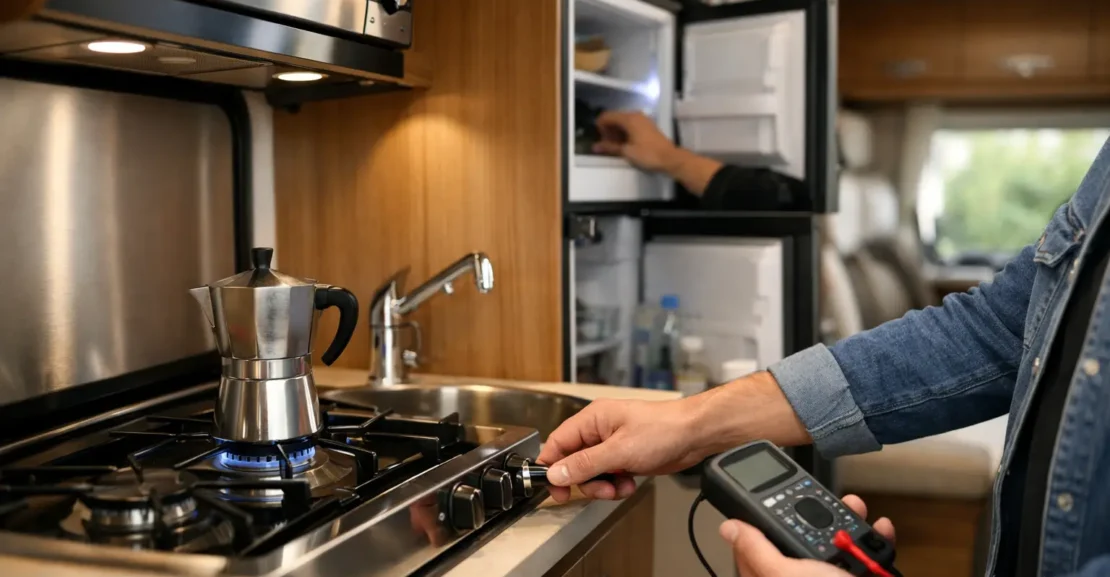
A motorhome can look immaculate on a sunny viewing day and still hide a fridge that only works on one power source, a water pump that cycles all night, or a heater that will not ignite. Knowing how to test motorhome appliances gives you a clearer picture of the vehicle you are considering – and helps separate small maintenance jobs from concerns that need professional attention.
For many buyers, the living systems are just as important as the engine and service history. You are buying a self-contained home on wheels, so allow enough time at a viewing to operate the appliances rather than simply being shown where they are. If possible, arrange the inspection when the motorhome is connected to 230V mains power and has enough battery charge, gas and water to test properly.
Start with the right conditions
Appliance testing is most useful when each system can be run in the way you would use it on the road. Ask whether the motorhome has been on mains power beforehand, whether the gas bottles are full and in date, and whether the freshwater tank contains water. A fridge that is already cold may have been running for hours, so establish which energy source it is using before drawing conclusions.
Take your time. Turn appliances off and back on yourself where it is safe to do so. Listen for unusual noises, watch for warning lights and check whether a system continues to work after you move from mains power to battery power. A seller should be comfortable explaining normal operation, but the test should not rely on reassurance alone.
Avoid dismantling appliances, touching gas fittings or opening electrical enclosures. If you notice a fault, the sensible next step is an assessment by a suitably qualified technician, gasfitter or auto electrician.
How to test motorhome appliances by system
Check the 12V battery and control panel first
The house battery powers much of a motorhome’s everyday comfort: lights, water pump, extractor fans, USB outlets, steps, toilet flush and often the control panel itself. Start by checking the battery voltage shown on the display, then turn on several 12V loads at once. Interior lights should remain steady rather than dimming sharply, and the water pump should not sound strained.
If there is a solar controller, confirm it is registering charge in daylight. This does not prove the solar system is delivering its full rated output, but it confirms the controller is communicating and charging is taking place. Also test whether the battery charges when the motorhome is connected to 230V power. A battery can show a healthy voltage immediately after charging yet have limited capacity, so ask about its age and replacement history.
Test lights, sockets and small electrical items
Switch on every internal and external light, including reading lights, awning lights, locker lights and bathroom lighting. Replaceable bulbs are minor, but a group of dead lights may point to a fuse, wiring or control-panel issue.
For 230V sockets, use a simple plug-in socket tester if available, or plug in a known working appliance such as a phone charger. Check outlets in the kitchen, lounge, bedroom and exterior locker if fitted. Test the RCD or safety switch using its test button only if you understand how the system should reset. It should trip and reset correctly. If it will not reset, do not treat that as a small inconvenience – it needs investigation.
Give the fridge enough time
Three-way fridges are a common source of uncertainty because they may run on 230V mains, 12V while driving and LPG when off-grid. Compressor fridges usually operate on 12V and 230V. First identify the type fitted, then test each available power mode according to the manufacturer’s controls.
On 230V, listen for the fridge starting and check for a power indicator. On gas, the burner should ignite cleanly and the flame should remain stable through the viewing window, where fitted. Do not put your face near the burner or attempt any repair. On 12V, remember that some systems are designed to operate only when the engine is running, which prevents the house battery from being flattened.
A fridge rarely becomes cold within a few minutes. The better test is to confirm it starts correctly on each source, then use a thermometer if it has been operating long enough. Ask the seller to have it running before your appointment and check that the freezer compartment is cold. Yellow staining, a strong ammonia smell or poor performance across all modes can indicate a more expensive issue, particularly with an absorption fridge.
Run the water system and inspect for leaks
Fill a glass from each tap and run both hot and cold water where applicable. The pump should operate briefly, then stop once pressure is reached. If it continues cycling when all taps are closed, there may be a leak, a loose fitting or a failing pump valve.
Check beneath the kitchen sink, around the shower mixer, inside lockers near the water tank and around the hot-water unit for dampness, staining or a musty smell. Open and close the shower drain plug, then run water long enough to make sure it drains freely. Also test the toilet flush and inspect the cassette compartment for clean seals, signs of leakage and a working vent.
Water pressure will vary between motorhomes, especially in older models, but it should be consistent. A weak flow could be as simple as a blocked tap aerator, or it could be a pump or plumbing issue. Context matters.
Test hot water, heating and cooking appliances
With the seller present, turn on the hot-water system using each energy source it is designed for. Some units heat on gas, some on 230V, and some offer both. Allow sufficient time for the water to warm, then carefully test the temperature at a tap. Check the outside vent area for obvious soot marks or damage, but do not interfere with the flue.
For the space heater, test ignition, fan operation and heat output. A brief fan run before ignition can be normal. Repeated clicking, warning lights, an unexplained gas smell or a heater that cuts out should be assessed before purchase. Carbon monoxide and LPG are not areas for guesswork.
Light each gas hob burner and check that the flame is mostly blue and even. Test the grill or oven if fitted, allowing it to warm up while you remain nearby. A yellow, uneven flame may simply require cleaning or adjustment, but it can also indicate incomplete combustion. Confirm the rangehood fan and kitchen extractor work as well, as these are easy to overlook until you are living in the vehicle.
Do not forget ventilation, air conditioning and the awning
Open roof hatches, windows and flyscreens. Test roof vent fans in all available speeds and confirm they open, close and seal properly. Water staining around vents is worth noting, even if the fan itself works.
If the motorhome has roof-mounted air conditioning, test it on mains power. It may take a few minutes to produce cold air, and its performance can be affected by a very hot day, but it should start without excessive vibration or repeated tripping. Air conditioning repairs can be costly, so a reluctant unit deserves a professional opinion.
Extend the electric step and awning if fitted. Although they are not appliances in the kitchen sense, they rely on the same living-system electrics and are part of the practical ownership experience. Check awning fabric for tears, mildew and smooth operation. Never force a stiff awning mechanism.
Record faults, then judge them in context
Make notes as you go and distinguish between a fault, a maintenance item and a feature you have not yet learned to operate. A blown bulb, worn tap washer or flat remote battery should not necessarily stop a good purchase. A fridge that will not select gas, a water leak inside cabinetry or an RCD that trips repeatedly carries a different level of risk.
Ask for manuals, service records, gas certificates and any evidence of recent repairs. In New Zealand, current self-containment documentation and gas compliance are separate matters from whether an appliance works, but both are relevant to a confident purchase. Where the vehicle is right for you but an appliance concern remains, obtain a repair estimate before agreeing on price or make the sale conditional on satisfactory inspection.
A proper walkthrough is not about trying to catch a seller out. It is about understanding the motorhome you may soon be relying on in a remote campground or during a South Island winter trip. At RVfinders, we encourage buyers to ask questions, operate the systems and take the time they need – because confidence at the viewing makes for far happier travels later on.