
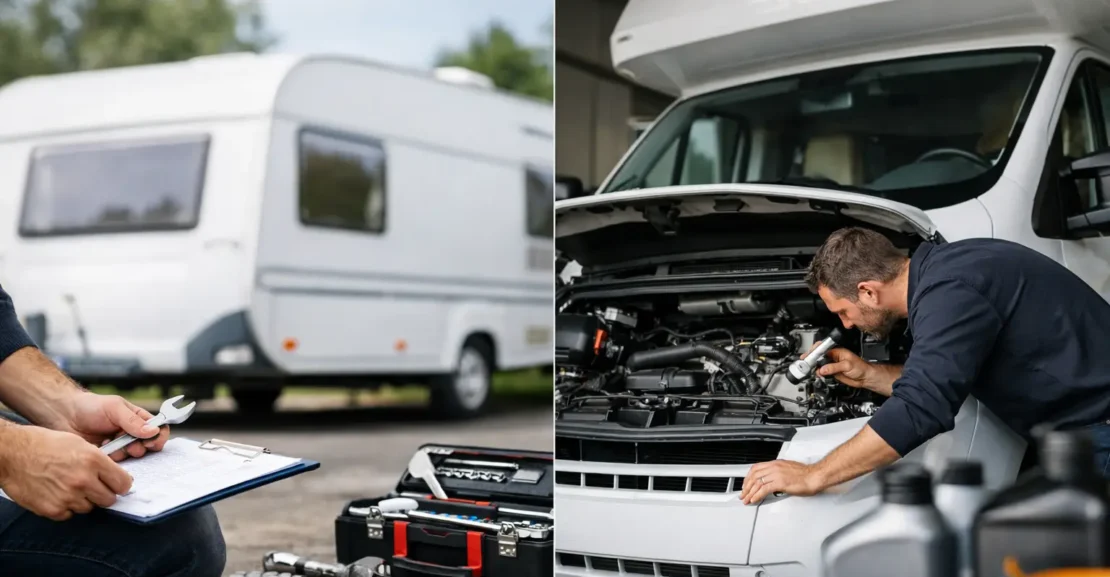
A caravan can look like the simpler option because it has no engine, while a motorhome promises one vehicle for both travel and accommodation. In practice, caravan versus motorhome maintenance comes down to how you travel, where you store your RV and how confidently you can stay ahead of small jobs. Neither choice is maintenance-free, but the costs and responsibilities sit in different places.
For many New Zealand couples, the deciding factor is not the purchase price. It is whether the vehicle will suit years of holiday touring, weekend escapes and time on the road without becoming a source of unexpected bills. Understanding the ongoing work before you buy helps you choose with clear expectations.
Caravan versus motorhome maintenance at a glance
A motorhome combines a road vehicle with a home on wheels. That means regular mechanical servicing, along with the same habitation care required in a caravan: water systems, gas, electrical equipment, seals, appliances and interior fittings. A caravan has no engine or drivetrain of its own, so its mechanical upkeep is usually less involved. However, it still needs safe running gear, sound brakes where fitted, good tyres and a reliable tow vehicle.
The caravan owner may spend less on the caravan itself but needs to factor in the servicing and capability of the vehicle doing the towing. A motorhome owner has one vehicle to maintain, insure and prepare for a trip, but its engine, transmission, brakes and suspension are often more complex and expensive than those of a family car.
The better option depends on the type of freedom you value. If you like setting up at a holiday park and using your car for day trips, a caravan can make practical sense. If you prefer moving frequently, stopping where the view is best and avoiding towing, a motorhome can be easier to live with despite its higher servicing commitment.
The motorhome maintenance picture
Motorhome maintenance starts with the base vehicle. Whether it is built on a Fiat, Mercedes-Benz, Ford or another chassis, it needs servicing according to the manufacturer’s schedule and its actual use. Low annual kilometres do not always mean low maintenance. Fluids, belts, seals, batteries and tyres can deteriorate with age, particularly when a vehicle spends long stretches parked up.
A routine service may feel familiar, but larger motorhomes can bring higher labour and parts costs. Access can be tighter, tyres may be commercial-grade, and brake or suspension components work hard under a fully laden vehicle. Diesel motorhomes also require attention to fuel systems and, where applicable, emissions equipment. Owners should keep a careful service record, as it supports reliability and resale confidence.
Then there is the living area. Roof and window seals need checking, ideally before winter and after any significant weather event. Water ingress is one of the most costly issues in any RV because damage may remain hidden inside walls, floors or cabinetry until it is well advanced. Early signs can include a musty smell, staining, soft spots, lifted wall coverings or corrosion around fittings.
Motorhomes also have house batteries, charging systems, solar panels, fresh and grey water tanks, pumps, toilets, gas appliances and 12-volt equipment. These are not difficult to maintain when inspected regularly, but they do reward use and attention. A battery that is allowed to sit flat, for example, may need replacing far earlier than expected.
What a caravan still needs
Removing the engine does not remove the need for regular care. Caravans rely on their chassis, coupling, jockey wheel, stabilisers, wheel bearings, tyres, lights and, on many models, braking system. These components deserve a check before every major journey, especially after the caravan has been stored for a season.
Tyres are a common trap. Caravan tyres can look barely used because they have travelled fewer kilometres, yet age, sunlight and prolonged stationary loading can compromise them. Check their condition, pressure and age, rather than judging them by tread depth alone. The same applies to the spare.
Wheel bearings and brakes should be inspected and serviced at suitable intervals by a qualified professional. A caravan that has spent time near the coast, crossed rough gravel roads or sat outside through wet winters may need more attention than one stored under cover and used on sealed roads. The underbody is easy to overlook, but it is exposed to water, road grime and corrosion.
Inside, caravan maintenance closely mirrors a motorhome. Keep seals clean, inspect roof penetrations, run water through the system, test the fridge and heating, and make sure doors, windows and lockers close securely. A caravan can still suffer serious damp damage, and because it may sit unused for longer periods, ventilation and storage conditions matter greatly.
Compliance, safety and the jobs worth booking in
Both caravans and motorhomes need to meet their relevant New Zealand roadworthiness and registration requirements. The appropriate inspection schedule can depend on the vehicle’s age, type and weight, so it is sensible to confirm what applies to the specific RV rather than relying on assumptions.
Gas and electrical systems deserve professional attention. Have appliances checked when there is any doubt about their operation, and keep documentation for gas work, electrical work and any self-containment requirements that apply to your style of travel. These are safety matters first, but accurate paperwork is also valuable when it is time to sell.
A regular professional habitation check can be worthwhile, particularly for a newer purchase or a higher-value motorhome. It provides an opportunity to identify moisture, gas, electrical or appliance concerns before a short break turns into a workshop booking. For owners who are not mechanically minded, this is often money well spent.
There are also straightforward checks that should become routine:
- Test lights, brakes, tyre pressures and the breakaway system where fitted before departing.
- Inspect roof seals, windows, vents and external locker doors for cracks or movement.
- Check battery condition, water levels and pump operation after storage.
- Look underneath for leaks, loose fittings, corrosion or damage after rough roads.
Storage changes the maintenance equation
Storage is one of the biggest influences on long-term RV condition. Under-cover storage reduces UV exposure and helps protect seals, paintwork, tyres and interior fabrics. If undercover space is not available, a breathable fitted cover may help, provided it is used correctly and does not trap moisture or rub against the bodywork.
For a motorhome, occasional use is generally better than leaving it motionless for months. A proper run allows the engine and drivetrain to reach operating temperature, helps keep brakes from binding and gives you a chance to spot concerns early. Avoid simply idling it in the driveway for a few minutes, as that is not the same as a proper drive.
For a caravan, take pressure off the tyres where practical, ensure it is level and well ventilated, and avoid leaving the handbrake engaged for prolonged periods if that risks binding. Security should be part of the plan too, including secure storage, wheel clamps or hitch locks where appropriate, and suitable insurance cover.
Budgeting realistically before you buy
It is tempting to compare only a caravan’s lower purchase price against a motorhome’s higher one. A more useful comparison is the total annual allowance. A motorhome budget should include scheduled servicing, tyres, repairs, habitation systems and potentially heavier vehicle components. A caravan budget should include running-gear maintenance, habitation upkeep and the additional load placed on the tow vehicle.
Condition matters more than age alone. A well-kept older RV with dry walls, documented servicing and a careful owner can be a more sensible purchase than a newer vehicle that has been stored poorly or neglected. Equally, a vehicle with a clean presentation should never be accepted as proof that its roof, underbody and systems are sound.
Before committing, allow for an independent pre-purchase inspection and ask to see service records, receipts and evidence of repairs. Test the appliances, inspect storage lockers, check for moisture concerns and understand what has recently been replaced. At RVfinders, this kind of practical conversation is central to matching buyers with an RV that suits not only their travel plans but also their comfort with ongoing care.
Choose the maintenance you are happy to own
A caravan may be the lower-complexity choice if you already have a suitable tow vehicle and enjoy establishing a base camp. A motorhome may be worth the extra mechanical responsibility if convenience on moving days and freedom from towing matter more to you. Both can deliver years of memorable travel when they are maintained proactively rather than repaired reactively.
The most reassuring purchase is rarely the one with the fewest apparent jobs. It is the one whose maintenance needs you understand, can budget for and feel comfortable managing before the first trip begins.