
A caravan can look perfectly matched to a tow vehicle in the driveway and still be overweight once the water tanks, gas bottles, food, bikes, outdoor chairs and holiday gear are loaded. Knowing how to check caravan weights before departure is one of the most practical ways to protect your safety, stay within legal limits and enjoy a more relaxed trip.
Weight is not a single figure on a sales listing or compliance plate. It is a set of limits that must work together: the caravan, its tyres and axles, the tow vehicle, the towbar, the towball and, in some cases, your driver licence. The only way to know where you stand is to compare the relevant ratings with the caravan as you actually travel.
Start with the weight terms on your caravan and tow vehicle
The terminology can feel confusing because older caravans, imported models and Australian-built caravans may use slightly different labels. Your caravan’s VIN plate, certification plate, owner’s manual and compliance documents are the best starting points. If a label is unclear, ask the manufacturer, importer or a qualified RV specialist rather than making an assumption.
Tare mass is the caravan’s weight as supplied by the manufacturer, usually without your personal gear and often without a full load of water or gas. It is useful for comparison, but it is not the number you tow at.
ATM, or Aggregate Trailer Mass, is commonly shown on Australian-built caravans. It is the maximum permitted loaded mass of the caravan, including the weight carried at the coupling. New Zealand documentation may use different terms, so always check the rating applicable to your specific caravan.
GTM, or Gross Trailer Mass, is generally the maximum weight carried by the caravan’s wheels and axles when it is hitched. It does not include the towball load carried by the vehicle.
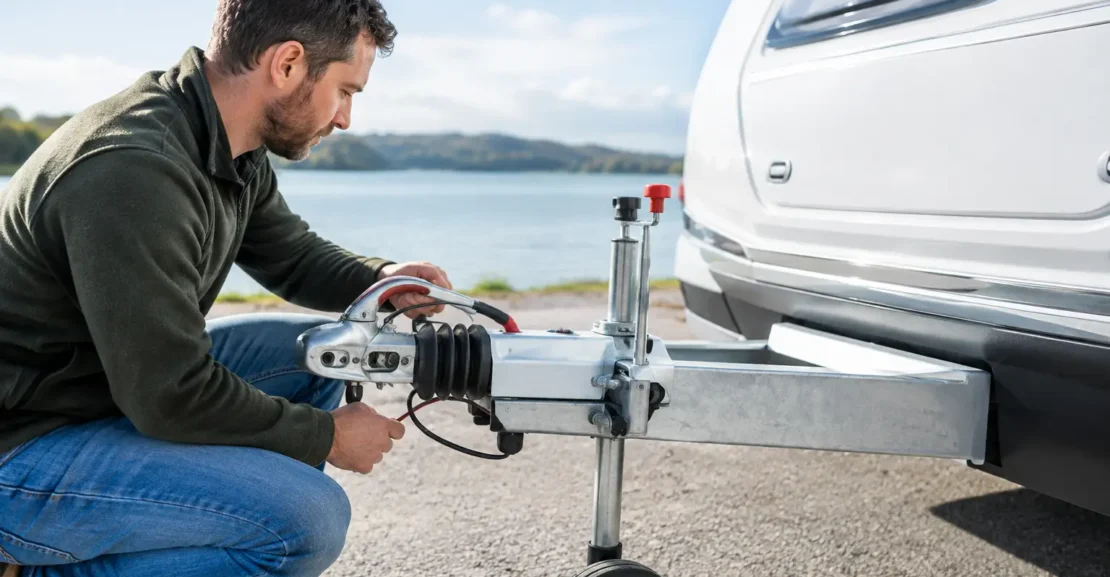
Towball load or ball weight is the downward load the caravan places on the tow vehicle’s towball. It counts towards the tow vehicle’s weight, not just the caravan’s. This is where many owners get caught out, particularly with a heavy front boot, twin gas bottles, a generator or bikes mounted forward of the axle line.
Your tow vehicle will have its own limits. Look for its Gross Vehicle Mass (GVM), Gross Combination Mass (GCM), maximum braked towing capacity, towbar rating and maximum towball download. The lowest relevant rating is the one that governs. A towbar rated for a particular trailer mass does not override a lower limit set by the vehicle manufacturer.
Why caravan weights need to be checked as a combination
It is possible for a caravan to be under its maximum loaded weight while the vehicle is over GVM, the rear axle is overloaded or the ball weight exceeds the towbar rating. Equally, a vehicle might be within GVM but the total vehicle-and-caravan combination exceeds its GCM.
The figures interact. When you couple up, the ball weight transfers load to the rear of the tow vehicle and can reduce load on the front axle. That can affect steering, braking balance and headlight aim. A weight-distribution hitch may improve the way a suitable rig sits and handles, but it does not increase any manufacturer’s weight ratings. It must also be compatible with both the caravan and the vehicle.
Do not rely on the often-repeated idea that ball weight should be exactly 10 per cent of the caravan’s mass. A sensible ball weight depends on the caravan’s design, actual load distribution and the vehicle manufacturer’s limits. Too little weight at the coupling can contribute to instability, while too much can overload the rear of the vehicle. The correct figure is one that remains within all specified limits and supports stable towing.
How to check caravan weights at a weighbridge
A certified public weighbridge is the most reliable way to establish your real-world weights. Weigh the caravan in travel-ready condition, not empty on a quiet weekday. Fill or partially fill tanks to the level you normally travel with, carry your gas bottles, fit accessories such as bike racks and awnings, and include the tools, food, clothing and equipment you usually take away.
Before arriving, make a note of every relevant limit from the caravan and tow vehicle plates. Take photos of the plates and keep the weighbridge ticket with them. It makes the numbers much easier to review afterwards.
Ask the weighbridge operator whether they can help you obtain separate axle readings. The most useful measurements are:
- the tow vehicle’s front and rear axle loads while the caravan is coupled;
- the caravan axle load while hitched and sitting level;
- the total combined weight of the complete outfit; and
- the caravan’s actual ball weight, measured with suitable rated equipment at normal coupling height.
Ball weight should not be guessed from how much the jockey wheel feels to lift. Use a purpose-built rated ball-weight scale or have it measured professionally. The caravan should be level and configured as it is when connected to the vehicle, because an altered height changes the load reading.
To work out the caravan’s actual loaded mass, add the caravan axle load to the measured ball weight. Compare this with the caravan’s permitted maximum loaded mass. Compare the caravan axle result with its GTM or axle rating, and check that no individual axle or tyre limit is exceeded.
For the vehicle, compare each axle reading and total vehicle mass with its front axle, rear axle and GVM ratings. Then compare the full combination weight with the vehicle’s GCM. This process may take a little longer than one pass over the scale, but it gives you far more useful information than a single combined figure.
Check tyre ratings and tyre pressures too
Tyres are part of the weight system, not an afterthought. The load index on each tyre must be sufficient for the weight carried by that axle, and pressures should follow the tyre or vehicle manufacturer’s guidance for the actual load. A caravan that is technically within its overall limit can still have overloaded tyres if its weight is poorly distributed.
Also inspect tyre age, sidewall condition and the spare. Caravans can travel relatively few kilometres while still ageing in storage or sunlight. A worn, damaged or under-inflated tyre makes a heavy outfit much less forgiving.
Load the caravan for balance, not just capacity
If your first weigh-in reveals a problem, resist the temptation to move weight randomly. Start with the heaviest items. Water is significant at roughly one kilogram per litre, so full tanks can dramatically alter axle and ball loads. Where tank position is fixed, travelling with less water may help, but only if it suits your route and available facilities.
Keep dense items low and close to the axle area where possible. Avoid filling the front storage compartment with heavy gear simply because there is room. Likewise, a rear-mounted bike rack can reduce ball weight and increase leverage behind the axle. It depends on the caravan’s layout, so measure again after any meaningful change.
The tow vehicle needs careful loading as well. Passengers, recovery gear, fridges, canopies and items in the boot all count towards GVM. A large ute canopy or rear cargo system may leave less payload than owners expect once the caravan’s ball weight is added.
Do not overlook licence and equipment requirements
In New Zealand, the combined weight of the vehicle and trailer can affect which driver licence class is required. A standard Class 1 licence has combination-weight limits, so check the current NZTA requirements if your setup is close to or beyond those thresholds. This is particularly relevant for larger caravans towed by heavy four-wheel drives or utes.
Your coupling, safety chains, brakes and electrical connection must also be correctly rated and maintained for the trailer. These items are not paperwork details. They are essential parts of a safe towing system.
When a pre-purchase weight check is worthwhile
If you are buying a caravan, weight should be part of the conversation before you fall in love with the layout. Ask what is included in the advertised weight, which accessories have been fitted, where the water tanks sit and what ball weight the caravan is likely to place on your intended tow vehicle.
A caravan with a generous payload can be a better long-term choice than one that appears lighter but has little capacity left after factory options. For first-time owners, a practical match is often more valuable than choosing the biggest caravan a vehicle can theoretically tow. At RVfinders, this kind of vehicle-and-caravan suitability discussion is part of helping buyers find an RV they can use with confidence.
A weighbridge ticket is not a once-only document. Recheck your setup after adding solar batteries, a bike rack, a new toolbox or other substantial accessories, and before a long trip with extra supplies. The best caravan setup is not the one that merely looks level outside the house. It is the one whose real travelling weights leave you comfortable margins for the road ahead.